STUDENT AFFAIRS


STUDENT AFFAIRS

Neumont University's Office of Student Affairs includes (from left to right) Michael Michaud, Larry Crandall, Erin McCormack, John Peppinger, Corrine Padilla, and Alice Nguyen.

Neumont University's Office of Student Affairs includes (from left to right) Michael Michaud, Larry Crandall, Erin McCormack, John Peppinger, Corrine Padilla, and Alice Nguyen.

With the biggest travel days of the year approaching, and (gasp!) the holidays soon upon us, we caught up with Neumont’s Student Affairs leadership to chat a little bit about students being home for break and some signs for parents and caregivers to look for to make sure their student is on the road to success.

Erin McCormack is Dean of Students for Neumont University and Corrine Padilla is Neumont University’s Student Life Coordinator & Housing Program Manager.

NU: What are some easy ways to find out how your student is doing?

EM: Ask them. But if you ask vague and open-ended questions, you’re going to get vague and open-ended answers.

CP: Exactly. Parents should ask specific questions: In what areas are you excelling? Where are you struggling? What skills do you need to learn to be more successful? What time do you get to sleep? What kinds of resources are available to you? For example, is there tutoring and are you using it?

EM: I think if there’s a lack of accountability by the student, that’s a sign that something is wrong – always blaming the teacher or if the student seems really angry about what’s going on at school. Students who own their missteps are in a great position. If we caused something and we know it, we can change it going forward, which creates a sense of control.  Those who blame others feel they are always at other people’s mercy which creates a sense of helplessness that is counterproductive.

NU: How about outside the classroom; are there external factors that can showcase how a student is adjusting?

EM: We’ve seen that a student’s peer group can have a tremendous impact on their success. It seems that an entire group often sinks or swims together. Some groups compete to push each other in their success at school. They get their work done, and then reward themselves with gaming after their assignments are complete. The opposite approach, just getting together to game, makes it hard to succeed.

CP: Ask your student about what they’re doing to fill their time, about their roommates, and if they’re getting along with them – about food, who’s buying and who’s cleaning. What is the division of power and what do those responsibilities look like? Students who are struggling to create a harmonious relationship with roommates are often distracted and overwhelmed. Fixing these issues allows them to focus on school.

EM: Specific questions: "Did you miss any classes? Did you miss any assignments? Why? What are you going to do to prevent missed classes and assignments going forward?"

CP: Ask: “What are some of your favorite activities?” Ask about the types of meals they’re eating and what types of meals they prepare.

NU: Speaking of food, should parents worry about the clichéd Freshman 15 in their student?

EM: What we see a lot more frequently than weight gain is students who are struggling with weight loss – they’re failing to eat or just prepare meals at all. 

CP: Extreme weight loss or gain – either end of the spectrum is usually a warning sign that something is not right.

NU: So what are some of the other warning signs to look for as signals that a student may be struggling?

EM: If they come home and are playing 15 hours of video games a day while on vacation, you can bet they’re having a similar experience at school.

CP: Sleep schedules are key – if they’re keeping extremely late hours or unnatural sleep schedules on break, it’s an easy insight into what’s happening on campus.

EM: When I see students in The Commons at 8 a.m. over break, I can tell it’s a student that’s going to succeed. If they’ve got the discipline to be up and active on break, I know they’ll go far. They don't have to be up at eight necessarily, but those who sleep until the afternoon on breaks return to school facing a serious battle with getting up on time for class.

NU: We talked about weight loss and gain.  What about other noticeable signs appearance-wise to look for?

CP: Any dramatic change in appearance is a red-flag.

EM: A couple of piercings and dyed hair are a pretty normal college change. Ten piercings? That’s dramatic and is cause for you to explore what's happening with your student.

NU: Additional concerns?

CP: It’s ok to ask to see their grades. Some students will push back saying they’re going to continue to do things on their own, and they should be respected for that. But hiding grades, being angry or skeptical, is not ok.

EM: There’s a delicate balance for parents between being too involved and not at all. There’s overbearing and then there’s oblivious – neither are helpful. Students whose parents are actively involved in their transition to college are more successful. Additionally, college is an expensive investment, and parents have a right to know how their investment is doing.

NU: That’s a good point. You wouldn’t turn over $75,000 of your retirement fund and never check to see how it was doing or where the money was going.

EM: But check in on them as an adult – not just a student. That’s such a big part of what happens here. Students are here for academics, but must simultaneously learn to be adults: manage their time, get to class, choose homework over video games, get along with roommates, buy groceries, budget their money, clean their apartment, cook, and so on.  It’s important to check and see how they are doing with these tasks. Failure in any one of these areas can sabotage school success.  Ultimately, parents should trust their gut. If you think something is amiss, something is probably amiss.

CP: You know your student best.

[This interview has been edited for content and clarity.] 

 
JONATHON MICHAEL


JONATHON MICHAEL

Jonathon earned the nickname “Tree” because of his height, but he has made a name for himself for different reasons at REI Systems. His current duties include supporting two teams throughout the year with new development and maintenance of an enterprise solution.

“That's just a fancy way of saying I maintain a website for a company that happens to be the U.S. Department of Health and Human Services (HHS),” he says. "Maintaining the site consists of fixing new and old bugs while introducing new functionalities in tandem, so communication with all parties involved is important.”

Like many students, Tree chose a computer science education from Neumont University for the accelerated program.

“Going to school year-round highlighted the work ethic needed in order to survive in the industry,” he says. “There are no summer breaks and short timelines.” 

We got a chance to hear a bit more from Jonathan about his experience at Neumont and in the field.

NU: What is your best Neumont memory?

JTM: It is hard to pick out one specific memory, but a few things that come to mind are the memories of struggle and overcoming the mental rigors of the course. I remember the staff that helped us through the rough moments when second thoughts lie in the back of our heads. And friendships that will last my lifetime.

NU: How did Neumont prepare you for your current role?

JTM: The career path of the computer science major is vastly broad and requires a passion to learn in order to stay current. Neumont helps by teaching students to disseminate information through critical thinking and curiosity. Neumont fosters an environment that is conducive for learning making absorbing all the knowledge easier.

The hands-on approach is beneficial since the majority of our jobs include coding. I have a friend who is attending a well-known university who is also pursuing computer science, but has hardly written any programs. Writing code is half of our jobs; therefore we must do it well.

Also Enterprise Projects – having insight into what positions are available is helpful for choosing where in the industry you want to work.

NU: Now that you’re in the industry, what do you think the industry is lacking?

JTM: There are several things that are missing from the computer science industry.

1. Best practices and adhering to standards. Neumont does a fantastic job in this area. When working in a group and dealing with other people's code, using best practices and standards is critical for the projects success.

2. A drive to add value to the project. Taking responsibility for the product and ensuring that everything is complete and then a little more.

3. More women. You might laugh at this one, but women approach solving problems differently. It is unfortunate that our field is dominated by men, but the more we advocate for diversity, the more diverse we will become.

NU: Any words of wisdom for current and prospective students?

JTM: Be diligent with the little things. I personally believe anyone can learn how to code and become a computer scientist. However, doing so requires a drive to push your knowledge to the limit and farther.

I recommend Neumont to prospective students looking for careers in computer science. I believe Neumont provides a good structure for teaching students how to think critically and solve problems: the root of all programming.

NU: What’s a tech trend you’re interested in and why?

JTM: 3D Printing is just amazing. We are really close to being able to print working organs.

Another tech that is interesting is self-driving cars. The idea that a driver is no longer required for a vehicle is going to be life changing for everyone.

NU: Since according to Stan Lee, Salt Lake boasts the best Comic Con in the world, if you had one super power what would you want it to be?

JTM: This is a tough one. I'd want the power to fly. I would be able to travel the world on a whim and never sit in traffic.

[This interview has been condensed and edited for clarity.]

 
BRETT KOTTER


BRETT KOTTER

Vivint's Utah headquarters show the perks of working in tech--great co-working spaces, fresh free food, and neat gadgets fill the office. We visited the home security company to catch up with Neumont University alumnus Brett Kotter. Among the gadgets and devices, Brett showed us the company’s latest project – the doorbell camera. And when we saw Brett’s corner office view, we knew life since Neumont has gone well for the 2009 graduate.

Brett shares his story of how working at a college help desk lead him to transfer universities and earn a bachelor's degree at one of the best computer science programs in the nation.

 
FLORENCE HERNANDEZ


FLORENCE HERNANDEZ

static1.squarespace.jpg

Florence Hernandez lives with a constant smile on her face. Some have even wagered she sleeps in a perma-grin. Her enthusiasm and positivity, coupled with a tenacious love for programming that earned her the votes as Neumont University’s first female class President.

 Whether taking votes at Project Showcase, programming her heart out, or giving a television interview to the press about the new Eccles Theater adjacent to Neumont, Florence is a joyous force to be reckoned with. She hails from North Richland Hills, Texas and is in her second year at Neumont.

We caught up with Florence over email to find a little more about her passion for java, project-based learning and desserts.

NU: First off, how much programming experience did you have prior to coming to Neumont?

FH: Before I came to Neumont, I took a year of computer science at Birdville High School. My teacher, Mr. Dix, was excellent and really pushed me to understand code. He could see my passion for it, and I am thankful that he started me on my path to coding success.

NU: And your favorite programming language?

FH: My favorite programming language is definitely Java! I'm a java baby—I started with it and it never stops being interesting.

NU: What’s a project you’ve enjoyed most during your time at Neumont?

FH: The project I enjoyed the most was when I was in my Second Quarter, it was a four person project for object-oriented programming. I was working with my friends: Brandon, AJ, and Nate, and we made a Binding of Isaac Calculator that allowed you to select your character, items, and other collectibles to calculate your damage. I learned A LOT of Java, and how to collaborate in a team. It was really fun and great time. 10/10!

NU: What has been the most surprising thing about your Neumont experience?

FH: The amount of friends that I made as soon as I came here. I was really afraid that being a girl would make people avoid me and dislike me because. This isn't really known as a woman's place. But everything worked out, and I have tons of friends and peers that respect me and my work.

NU: Tell us a tech trend you’re interested in and why.

FH: I'm not really too focused on one tech trend, but I guess I am really involved with any kind of video game news, releases, updates, watching videos of them, what have you. I eat, sleep, and breathe video games so keeping up with them is only natural. 

NU. Finish this sentence: “While attending Neumont, I’ve experienced…”

FH. While attending Neumont, I’ve experienced, independent and project leadership skills, along with collaboration on an industry level.

NU: And looking towards the future: what's your dream job? 

FH: My dream job for my career is to work at Google. However, I would like to be an entrepreneur and open my own coding bakery, kind of like a Starbucks but for coders and with tons of desserts.

[This interview has been edited for clarity.] 

 
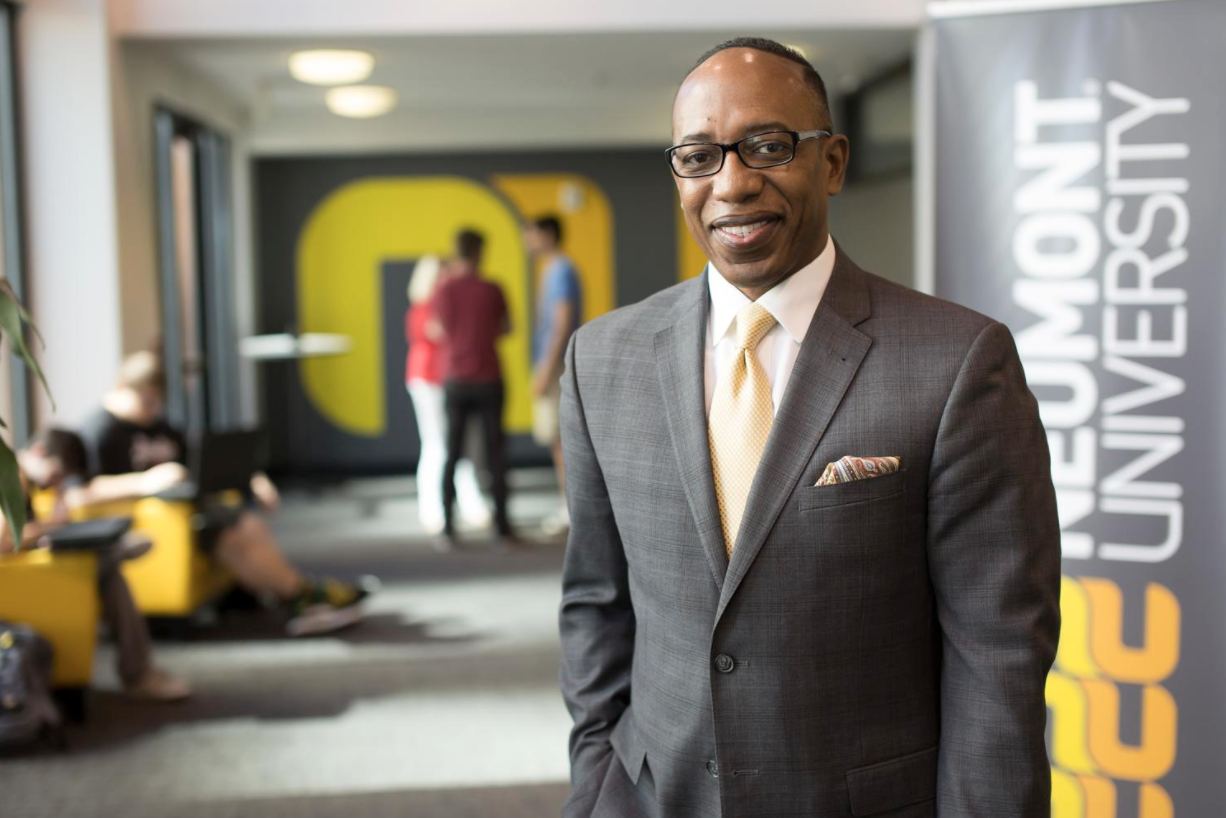
NEUMONT'S PRESIDENT


NEUMONT'S PRESIDENT

static1.squarespace-1.jpg

From his office on the fourth floor of the historic Tribune Building on Main Street in downtown Salt Lake City, Neumont University President Shaun McAlmont, can see and hear progress. 

Next door to the computer science-focused university, the $110 million, 2,500-seat George S. and Dolores Doré Eccles Theater is under construction – set to open in 2016, with an additional $12.8 million facelift for Regent Street and Orpheum Avenue creating a new arts district, right in the institution’s back yard.

“We’re smack in the middle of progress,” McAlmont muses, and you get the feeling he’s talking about more than the adjacent construction.

Although McAlmont is relatively new to his post at Neumont, it hasn’t taken him long to settle in. He brings a unique skill-set to the university, where students earn bachelor’s degrees in three years. His résumé includes more than 20 years of experience in the field of education and training, including roles at Stanford University and Brigham Young University. He was most recently the CEO of Lincoln Educational Services—a technical education institution with campuses in 15 states.

McAlmont’s enthusiasm for his new position is hard to miss, especially when he speaks about the connection he feels to Neumont students. Originally from Canada, McAlmont says he knows what it’s like to be different – something a lot of Neumont students can relate to. He attended Brigham Young University on a track scholarship in the late 1980s – arriving at the predominantly LDS campus as one of the school’s few minority students and a Catholic. To say he was not a typical student seems almost laughable.

 
KORVYN DORNSEIF
 

KORVYN DORNSEIF

Enterprise Projects are key to Neumont University’s success in helping grads get hired. They place student teams in a real companies developing software and working on other important tech tasks during their final year of school. In addition to refining technical skills and professionalism, Enterprise Projects help students build a strong network of connections in the tech industry through the projects.

One of Neumont’s Enterprise Partners, Towers Watson, has hired more than 30 Neumont graduates in less than 10 years. Towers Watson is an international professional services company with a key office in Salt Lake City.

“We rely heavily on Neumont to educate skilled developers,” says Korvyn Dornseif, Nuemont Alum (Class of 2006) and vice president exchange solutions at Towers Watson. “We know exactly what to expect from them, and we don’t have to wash away any bad practices. They’re passionate about their work.”

Joshua Kirk, director of quality assurance at Towers Watson says Neumont graduates are “very self-motivated, and they’re comfortable asking the right questions. They’ve all come from the Enterprise Projects, so they’re all familiar with our business and can hit the ground running.”

Although 82 percent of Neumont University’s students come from out-of-state, more than half of them accept their first job in the tech industry at a Utah-based company. As reported in Forbes, Utah was recently ranked #2 Fastest-Growing States for Tech Jobs in 2015, and Neumont is playing a key role to help further that distinction.

We met up with Korvyn to discuss his Neumont experience and why the partnership with Towers Watson and Neumont works so well.